

I thought I’d share a few of my favorite marketing-related books with you that I read throughout 2019. Okay, in the spirit of transparency: I didn’t actually read each of them; I mostly listen to audiobooks these days while running on the treadmill, walking the dogs, or cooking dinner. Multitasking is on trend, right? So, here they are, my five favorites (in the order in which I read them):
1. The Non-Designer’s Design Book (fourth edition) by Robin Williams

As a non-designer, I felt this book truly delivered: It wasn’t too technical for beginners, and it taught me how to create basic designs.
It’s split into two main parts, Design Principles and Designing with Type, and includes a list of all typefaces used, a mini-glossary, and additional resources.
This book is filled with examples that illustrate how to properly employ design principles, discusses design with color, branding and various document types, such as business cards, flyers, newsletters, and résumés, explains type categories, and shows how to contrast type effectively.
Noteworthy quotes:
“Once you can name something, you’re conscious of it. You have power over it. You’re in control. You own it.” (p.11)
The author uses this quote to introduce the four design principles, stating that once readers know the names of these principles, they will be in control of their pages (p. 12). She was right, at least in my case: After I had read about the four principles and knew their names and what they were, I started seeing designs differently. I noticed when elements weren’t spaced effectively or aligned properly, when they were repeated to create a recognizable design, and when they were contrasted with intent.
“Don’t be a wimp” (p. 85)
This quote introduces a list of things not to be afraid of in the design process, such as blank space, asymmetrical or uncentered formats, very large or very small words, and very bold or very minimal graphics, and highlights the importance of using contrast with intent.
Being too careful during the design process may just result in a boring or ineffective design. So, I’ve been reminding myself that if I want to contrast elements, I have to make it obvious that the contrast is intentional and has a purpose.
2. Likeable Social Media: How To Delight Your Customers, Create an Irresistible Brand, & Be Generally Amazing On All Social Networks That Matter (third edition) by Dave Kerpen

This book focuses on how to use social media platforms to improve brand image, gain and retain customers, and grow a business. It is structured as a kind of guide, is filled with anecdotes from the author’s personal and professional life, which lighten the mood and make the content and lessons both memorable and easy to process, and includes a refresher for selected social networks, highlighting their key features and best uses.
Noteworthy quotes:
“Listen carefully, be transparent, be responsive, be authentic, tell great stories—the qualities that would make you the hotshot at the party—and your organization will become more likeable on social networks.” (p. 7)
“Know your audience. That’s your job—as a marketer.” (p. 282)
3. Switch: How to Change Things When Change Is Hard by Chip Heath and Dan Heath
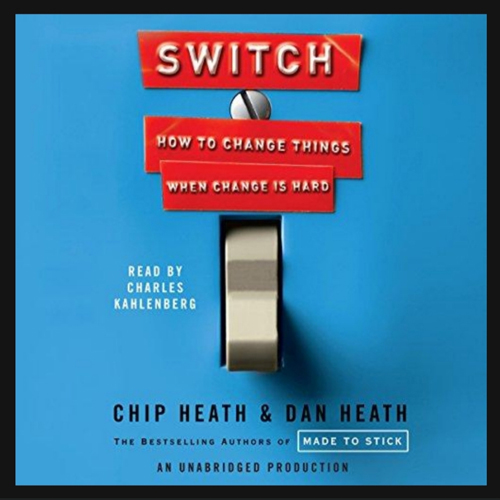
This book provides readers with a framework for how to effect a change in behavior. It’s filled with tons of examples and offers an occasional joke to lighten the mood.
Noteworthy quotes:
Based on an analogy by Jonathan Haidt in The Happiness Hypothesis (see p. 7):
“Direct the Rider. […] Provide crystal-clear direction.” (p. 17)
“Motivate the Elephant. […] It’s critical that you engage people’s emotional side—get their Elephants on the path and cooperative.” (p. 17)
“Shape the Path. […] When you shape the Path, you make change more likely.” (p. 18)
4. Start with Why: How Great Leaders Inspire Everyone to Take Action by Simon Sinek

This book is about leadership, how to build long-lasting success in an organization, and how to achieve loyalty among employees and customers alike. It’s pages and pages of inspiration based on the author’s concept of The Golden Circle, which can be applied to building a business and to becoming a better leader as well as in marketing.
Noteworthy quotes:
“People don’t buy WHAT you do, they buy WHY you do it.” (p. 58)
“We turn away business because those potential clients don’t believe what we believe.” (p. 79)
These words truly resonate with me. It is imperative to define your own values and reasons for doing business and then work with the right clients, those who share your values and what’s important to you. If you find clients who believe what you believe, negotiating adequate compensation may also be much easier and, of course, working with like-minded clients in itself makes for a more comfortable work environment.
5. Social Media ROI: Managing and Measuring Social Media Efforts in Your Organization by Olivier Blanchard

I started reading this book while I was taking a marketing class and am actually still working my way through it. It focuses on connecting social media efforts to specific business goals rather than treating them as separate endeavors, offers examples that illustrate how to set goals, create a strategy, and define tactics, and highlights the relevance and value of social media marketing for achieving business objectives.
Noteworthy quotes:
“Your business doesn’t plug into social media. Social media plugs into your business.” (p. 16)
“This is where social media programs should begin: with focused listening rather than unfocused publishing.” (p. 129)
Now, what to read in 2020? If you have any recommendations, please feel free to share them with me in the comments!

 Denise Josey